
CPS has released the official score distribution for the 2026 PreACT 9, which gives families a clear picture of where their child's score actually stands. With the GoCPS application due Friday, November 13 at 5 p.m., here's what the numbers show, what we think they mean for Payton, Northside, Whitney Young, Jones, and Lane Tech.
How the 640-point score works
Selective Enrollment applications are now scored out of 640 points, split evenly between the test and grades:
Test (up to 320): the PreACT 9 Secure composite × 10. The composite covers English, Reading, and Math only; Science doesn't count.
Grades (up to 320): the final 7th-grade GPA × 80.
A student with a 24 composite (240) and a 3.75 GPA (300) has 540 points. A student with a 28 and a 4.0 has 600.
When totals tie, CPS looks at the HSAT Math score first, then Reading, then a random lottery. Because composites are whole numbers and many top applicants have a 4.0, totals at the high end will bunch up at multiples of 10. That means the Math sub-score is likely to decide a lot of seats at the margin.
How about 23,400 students scored
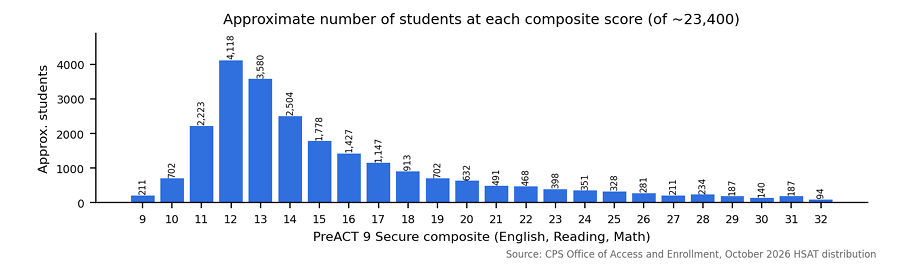
The average composite was about 15, and roughly 61% of students scored between 11 and 15. The most common score was 12. Above 20, the numbers thin out fast.
Three things stand out:
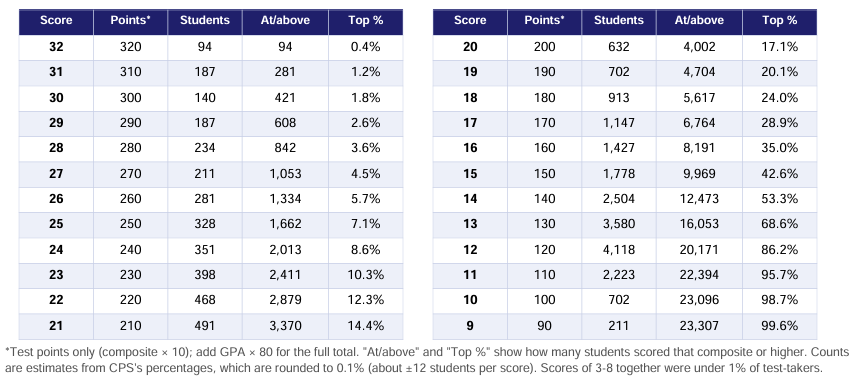
The middle is crowded. Moving from a 13 to a 15 passes about 6,000 students. In the middle of the range, a single point matters a lot.
The top is thin. Only about 94 students earned a perfect 32, and about 420 scored 30 or higher.
High scores are rarer than they look online. Parent forums skew toward families with top scores who choose to share them. A 20 is already top ~17%, and a 24 is top ~9%.
Note that student counts are our estimates from CPS's published percentages, which are rounded to the nearest 0.1%. Any single score could be off by about 12 students either way.
Projected 2027-28 cutoffs
With a 4.0 seventh-grade GPA, we estimate Tier 4 students will need roughly a 31-32 for Payton, 30-31 for Northside, 27-28 for Whitney Young, 26-27 for Jones, and 22-24 for Lane Tech. Lower tiers need meaningfully less.
The table shows the composite we think each school and tier will require, with total points (assuming a 4.0 GPA) in parentheses.
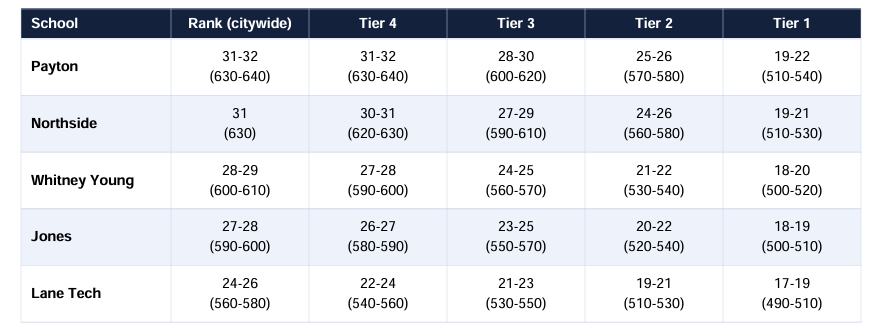
Note that about 30% of each school's seats go to the highest scorers citywide ("rank"). The other 70% are split evenly across the four socioeconomic tiers, so students mainly compete within their own tier.
How did we get these numbers? Under the old 900-point system, the test half was based on percentile rank, so each school's past cutoff implies a percentile. We converted that percentile to the composite sitting at the same spot in this year's distribution. For example, Whitney Young's Tier 4 cutoff was about 880 last year. Subtracting 450 grade points for straight A's leaves 430 test points, or about the 96th percentile. This year, the top ~4.4% of students scored 27 or higher. Additionally, Lane Tech made about 1,205 offers last cycle, and only about 2,000 students citywide scored 24 or higher. That fits with Lane's cutoffs sitting several points below the other four schools.
A note on Payton and Northside. With only about 94 perfect scores, many Tier 4 and rank seats at these two schools will likely be decided at 630 points by the tiebreaker. A 31 composite with a 32 in Math is in a much stronger position than a 31 with a 29 in Math.
Where these estimates need context
These are projections, not official CPS figures, and actual cutoffs could land a point or two either way. Published prior-year cutoffs also vary by source (reported Payton Tier 1 cutoffs range from the high 790s to the high 830s), so each estimate is a range. The biggest sources of uncertainty:
GPA assumptions for Tiers 1-2. A 4.0 is a safe assumption for Tiers 3-4 at these schools, but less so for lower tiers. If admitted Tier 1-2 students had lower GPAs, their test percentiles were higher, and those cutoffs could run 1-2 points above our estimates.
The top of the old test was compressed. Old percentiles capped at 99, producing lots of perfect 900s. The new test spreads out the top, which makes the Payton and Northside Tier 4 estimates the least certain.
Shifting preferences. Families report rising interest in Lane Tech and Whitney Young this year. If that holds, those schools could come in a point higher.
Rounding. The student margin per score matters most at 31-32, where so few students sit.
Additionally, you may see conversions online that scale old 900-point cutoffs straight down to 640. Those overstate the bar, especially at Lane and Jones, and shrink the gap between tiers. A percentile scale and a composite scale don't move in step, so don't use those figures as targets.
What to do before November 13
Rank schools in your true order of preference. Listing a reach school first costs nothing, because your child is still considered for every lower choice until they're matched.
With that being said, it can be useful to use these estimations to set expectations and pick strong backups. For example, a Tier 4 student with a 26 should still list Payton first if it's their top choice. But that family should treat Jones and Lane as the realistic outcomes, look at public schools with great AP/IB programs, and consider private school or Catholic school applications as a backstop.
If your student is interested in private or Catholic high schools, Test Prep Chicago can help them succeed on the necessary entrance exams. Because Catholic high schools, which utliize the HSPT, and private high schools, which utilize the ISEE, also use test scores for scholarships and class placement, a strong score can make a real difference. Interested students can now enroll in our HSPT one-day Palooza workshops (sign up here), or ISEE/HSPT individual tutoring sessions (sign up here). Sign up now to help your student prepare!
Key dates
GoCPS application closes: Friday, November 13, 2026, at 5 p.m.
Offers released: February 12, 2027. CPS publishes official point totals after offers go out.
Questions about your child's score or rankings? Reach out to Test Prep Chicago at info@testprepchicago.com.
Sources: CPS Office of Access and Enrollment, "Understanding HSAT Scores" (updated 10/29/2026); CPS GoCPS scoring rubric and Lane Tech admissions profile; publicly reported prior-year cutoffs from CPS and parent forums. Student counts and cutoff projections are Test Prep Chicago estimates, not official CPS figures.